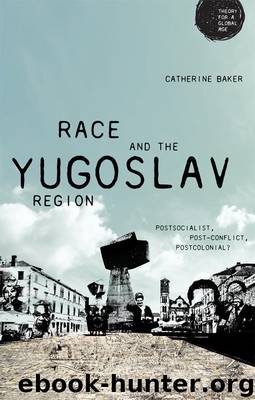
Race and the Yugoslav region by Catherine Baker
Author:Catherine Baker
Language: eng
Format: epub
ISBN: 9781526126603
Publisher: Manchester University Press
Published: 2018-02-06T02:00:00+00:00
Both the deliberate rejection of social alternatives in post-Yugoslav ethnonationalisms, and the consequent dominance of nationalism and ethnopolitical conflict as frames for research, have created a politics of knowledge production – inside, outside and across the permeable inside–outside of, the region – that pushes state socialism's geopolitical complexity towards or beyond the margins of public consciousness. Socialist Yugoslavia's geopolitical identity, so often called ‘between East and West’, could involve even more than balancing Europe's privileged West and Othered East; sometimes it pulled Yugoslavia southwards out of Europe altogether, into the post-Bandung configuration that for scholars like Mignolo (2011: 273) ignited the decolonial moment. But this was not the first ambiguous racial formation in the Yugoslav region: even before unification, multiple such formations already circulated through the region, creating contradictory points of identification. Their legacies of racialised thinking and representation were translated into identity-making politics that even predated state socialism, let alone the postsocialism in which they would be expressed through transnational politics of race and whiteness that persist into the present.
Notes
1 Todorova's essay on temporalities and the history of European nationalism does not return to this point – yet it has more transformative implications than she suggested.
2 With thanks to Dario Brentin.
3 Slovenian folklore contains another coastal abduction narrative where a black stranger kidnaps a woman, ‘Lepa Vida’ (‘Pretty Vida’). The song, adapted in 1832 by the national poet France Prešeren, terms the abductor ‘črn zamorec’ (‘the black “zamorec” ’, meaning both ‘man from overseas’ and ‘Negro’, and a racial slur in modern Slovenian). Marjetka Golež Kaučić (2002: 165), referring obliquely to past criticisms of racism in ‘Lepa Vida’, argues that the song dates from when Arab/Moor slave-traders were capturing coastal dwellers and so ‘negative attitudes towards the “zamorec” … have nothing to do with racism’ – yet a nineteenth- or twentieth-century listener would still hear contemporary as well as historic undertones in ‘zamorec’. With thanks to Julija Sardelić.
4 Greek sailors had called Korčula ‘Black Korčula’ for its thick forests.
5 Though Woolf (2002: 177) argues that Fortis could not find ‘a racial or physiognomic formula to sum up the national distinctiveness of the Morlacchi’, few tropes were more common than ‘the Hottentots’ in producing European imaginations of race and sexuality (Gilman 1985).
6 Did this title symbolically cast satellites like East Germany as ‘sons’ of Soviet Russia?
7 Afghanistan, Burma, Cambodia, Ceylon, the People's Republic of China, Cyprus, Egypt, Ethiopia, the Gold Coast (soon to become Ghana), India, Indonesia, Iran, Iraq, Japan, Jordan, Laos, Lebanon, Liberia, Libya, Nepal, Pakistan, the Philippines, Saudi Arabia, Sudan, Syria, Thailand, Turkey, North Vietnam, South Vietnam and Yemen.
8 Attendees were Afghanistan, the Algerian National Liberation Front, Burma, Cambodia, Ceylon, Congo, Cuba, Cyprus, Ethiopia, Ghana, Guinea, India, Indonesia, Iraq, Lebanon, Mali, Morocco, Nepal, Saudi Arabia, Somalia, Sudan, Tunisia, the United Arab Republic, Yemen and Yugoslavia (Alden, Morphet and Vieira 2010: 50).
9 This uses ‘white but not quite’ differently from Anna Agathangelou (2004b: 88), who describes stigmatisation of sex-workers from postsocialist European countries, but both point to shifting racial identifications projected on to postsocialist Europe.
Download
This site does not store any files on its server. We only index and link to content provided by other sites. Please contact the content providers to delete copyright contents if any and email us, we'll remove relevant links or contents immediately.
| African-American Studies | Asian American Studies |
| Disabled | Ethnic Studies |
| Hispanic American Studies | LGBT |
| Minority Studies | Native American Studies |
Cecilia; Or, Memoirs of an Heiress — Volume 1 by Fanny Burney(32527)
Cecilia; Or, Memoirs of an Heiress — Volume 2 by Fanny Burney(31928)
Cecilia; Or, Memoirs of an Heiress — Volume 3 by Fanny Burney(31916)
The Great Music City by Andrea Baker(31901)
We're Going to Need More Wine by Gabrielle Union(19020)
All the Missing Girls by Megan Miranda(15892)
Pimp by Iceberg Slim(14464)
Bombshells: Glamour Girls of a Lifetime by Sullivan Steve(14038)
For the Love of Europe by Rick Steves(13821)
Talking to Strangers by Malcolm Gladwell(13332)
Norse Mythology by Gaiman Neil(13317)
Fifty Shades Freed by E L James(13216)
Mindhunter: Inside the FBI's Elite Serial Crime Unit by John E. Douglas & Mark Olshaker(9298)
Crazy Rich Asians by Kevin Kwan(9262)
The Lost Art of Listening by Michael P. Nichols(7476)
Enlightenment Now: The Case for Reason, Science, Humanism, and Progress by Steven Pinker(7288)
The Four Agreements by Don Miguel Ruiz(6728)
Bad Blood by John Carreyrou(6601)
Weapons of Math Destruction by Cathy O'Neil(6248)
